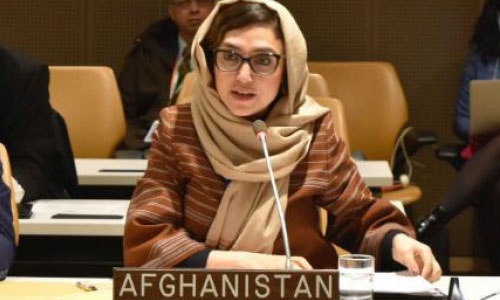
NEW YORK - Afghanistan’s Permanent Representative to the UN Adela Raz on Saturday told the UN Security Council that Kabul’s approach to counter-terrorism was a comprehensive one.
This included strengthening the national legislation to meet provisions of various treaties, conventions and UN resolutions, – including this Council’s, to combat terrorist financing, she said.
Addressing the Security Council’s open debate on preventing and combating the financing of terrorism she said Afghanistan being the prime victim of terrorism fighting various terrorist groups in the battlefield, including Foreign Terrorist Fighters (FTFs) coming from outside.
Preventing financing of terrorism was an important part of our national counter-terrorism strategy, she said, adding “Our National Security Council is leading the inter agency efforts to implement the strategy. We have established a Task-Force, which is comprised of the Attorney General’s Office, Ministry of Finance, the National Directorate of Security (NDS) and Fin TRACA. Its mandate is to ensure the implementation of legal frameworks to prevent money laundering, and any other un-regulated currency flow that helps terrorists to finance their activities.”
“Progress in this area has led to our compliance with international standards. This was recognized by the Financial Action Task Force (FATF), which removed Afghanistan from its compliance watch-list. In the broader context, our efforts are also in line with commitments under the International Convention on Suppression of Acts of Terrorism and the UN Convention against Corruption,” said Raz.
Afghanistan was engaged in efforts to disrupt the links between terrorism and organized crimes. Afghanistan had long been engaged in fight against narcotics, with a special focus to prevent the Taliban and other affiliate groups, from the illicit drug proceeds. “Under our national counter narcotic strategy, we are taking actions across multiple fronts such as eradication; public awareness and alternative livelihoods,” she said.
Last year alone, approximately 3,000 operations were conducted. From which, close to 3,500 individuals, including foreign nationals, were apprehended and prosecuted. Similarly, drug-processing laboratories and storage facilities were destroyed through joint military operations. This had disrupted the Taliban’s ability to benefit from narcotics revenue. In addition, more than 200 tons of illicit drugs confiscated in the course of one year, she said.
“We have improved the security at national airports and border-crossings to detect, deter and prevent trafficking. This shows our strong commitment to root-out the illicit drug economy, and address the linkages between terrorism financing and narcotics. These measures led to decrease drug production last year, as reflected in UNODC’s most recent Survey as well,” the Afghan envoy to the UN Security Council said.
She stressed the problem of narcotics in Afghanistan must be seen in the context of a complex issue. “We must recognize that only a robust and comprehensive effort, with international and regional partners – entailing all components of the problem: production; trafficking and consumption – can achieve the shared objective, which is completely eliminating the narcotics production and trade,” she said.
To ensure our success, Raz called for a more cohesive & unified regional approach. “Especially our immediate neighbors can play an effective & strong role to confront the nexus of transnational criminal activities. The inflow of resources that finance and support the terrorist activities, such as trafficking of weapons and chemical precursors do arrive from outside of Afghanistan, and that is where we need to have a regional comprehensive approach in combating this menace,” she believed. (Pajhwok)
Home » Afghanistan » Afghanistan Enacts Comprehensive Counter-Terrorism Strategy: Raz
Afghanistan Enacts Comprehensive Counter-Terrorism Strategy: Raz