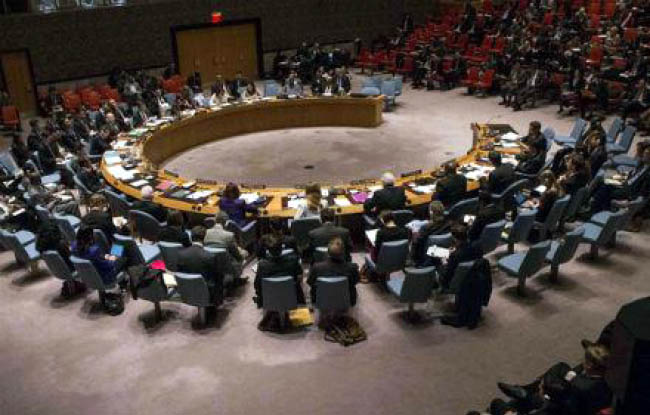
NEW YORK - Tadamichi Yamamoto, the Secretary-General’s Special Representative for Afghanistan, on Monday briefed the 15-member Security Council in New York and said the security situation in the country further deteriorated during the reporting period with intensifying armed clashes between the Afghan security forces and the Taliban.
He said that overall, the number of armed clashes between January and October 2016 increased by 22 per cent over 2015, reaching its highest level since the United Nations started recording incidents in 2007 and surpassing the previous record year of 2011.
Although successful in securing all provincial capitals, the Afghan security forces continued to be challenged by the Taliban across Afghanistan, he said.
According to Yamamoto, throughout the fall, the Taliban maintained a high operational tempo, intensifying its pressure on the provincial capitals of Helmand, Uruzgan, Farah and Kunduz while continuing to challenge government control in key districts and attempting to cut off key highways and supply routes.
“Between 16 August and 17 November, the United Nations recorded 6,261 security incidents across the country, which represented a nine percent increase compared with the same period in 2015 and an 18 percent increase against the same period in 2014,” he said.
“On 3 October, the Taliban entered the Kunduz city center. Expelled after only one week, Taliban fighters have maintained a significant presence in the city outskirts, despite clearance operations by the Afghan security forces supported by international military forces. The Taliban also captured the district administrative centers of Ghormach (Faryab), Omnah (Paktika) and Nawah-ye Barakzai (Helmand), in addition to launching offensives against district centers in the north-eastern, northern, south-eastern and eastern regions. The security forces have retaken control of Ghormach only,” he said.
According to him, anti-government elements continued attacks through abductions, intimidation and assassinations. In total, from 16 August to 17 November, 183 assassinations, including 27 failed attempts, were recorded, representing a 32 per cent decrease against the same period in 2015.
In addition, 80 abductions were recorded across the country, including 11 instances of mass abductions.
“The number of suicide attacks increased to 19 from 18 in the same period in 2015,” he said.
High-profile attacks in Kabul continued, including a complex attack against the Ministry of Defense in September, which resulted in 41 people killed, and for which the Taliban claimed responsibility.
On 12 November, the Taliban claimed responsibility for a suicide attack against the Bagram airfield in Parwan province, which resulted in four people killed.
Yamamoto stated that the operational capacity of the Afghan security forces remained under strain in the areas of command and control, leadership and logistics.
“Some progress was achieved in improving Afghan Air Force readiness and operational engagement. In October, Afghan Army troop levels and Afghan National Police numbers reached 87 per cent and 95 per cent, respectively, of target amounts,” he said.
According to him, fighting also continued with Daesh.
“Since my previous report, Afghan security forces, supported by international military assets, have conducted regular air and ground operations against ISIL-KP (Daesh Afghanistan) in both Nangarhar and Kunar provinces. These operations have confined the group’s presence in both provinces.
“An additional, smaller presence of ISIL-KP exists in Nuristan province. ISIL-KP conducted four suicide attacks, including on 11 October in Kabul, on the holiday of Ashura, and on 21 November in Kabul against a Shia mosque. Other attacks claimed by ISIL-KP included a suicide attack on 31 October against the guesthouse of community leaders in the Pachir wa Agam district of Nangarhar province and a suicide attack on 16 November against the vehicle of the presidential protection security forces in Kabul, which resulted in the death of eight civilians and injured 13.”
He also said in the past three months, relations between Afghanistan and Pakistan have remained strained.
“Nevertheless, dialogue continued, including on economic cooperation.”
President Ghani met the Adviser to the Prime Minister of Pakistan on Foreign Affairs, Sartaj Aziz, on the margins of the Brussels Conference on Afghanistan. Pakistan pledged $500 million in economic assistance to Afghanistan and was publicly thanked by both Ghani and Abdullah.
“However, several members of the lower house of the National Assembly, as well as demonstrators in Paktika province on 7 October, called upon President Ghani to reject the assistance from Pakistan and accused Pakistan of supporting terrorism, calling for its cessation. President Ghani condemned the attack in Quetta, Pakistan, on 24 October, during which at least 61 Pakistani police cadets were killed, and reiterated his call for regional cooperation against terrorism,” said Yamamoto.
He also stated that Afghanistan undertook efforts to deepen engagement with Gulf States, including on a peace process and cooperation on counter-terrorism.
He outlined progress made on infrastructural development and security cooperation between Central Asian countries, Afghanistan and the Islamic Republic of Iran.
He spoke of the new railway link between Herat and Iran and the one between Turkmenistan and Aqina, Afghanistan.
He stated that Afghanistan and Uzbekistan increased their engagement during the reporting period.
Yamamoto stated that between 1 July and 30 September, the country task force on monitoring and reporting documented and verified 438 incidents that resulted in 919 child casualties (245 deaths and 674 injuries). Ground engagements remained the leading cause of child casualties, resulting in 512 casualties, followed by improvised explosive devices, with 149 child casualties, and explosive remnants of war, with 135 child casualties.
“The task force attributed the remaining child casualties to tactics including aerial bombardments, incidents of targeted killing where children were bystanders, and suicide attacks,” he said.
The country task force attributed 411 child casualties (45 per cent), the largest number, to anti-government elements, including 324 casualties attributed to the Taliban, followed by pro-government forces (33 per cent), of which 82 per cent were attributed to the Afghan National Defense and Security Forces, he said.
During the reporting period, the task force verified 38 incidents targeting or affecting health services and health-related personnel, compared with 19 in the previous quarter. The task force also verified 34 incidents targeting or affecting education and education-related personnel, three incidents of abductions involving one girl and 10 boys and 28 incidents of denial of humanitarian access.
“The task force verified the recruitment and use of at least nine boys. The majority of the violations were attributed to anti-government elements. The Ministry of the Interior continued to expand the number of child protection units in Afghan National Police recruitment centers and opened four new units in Daykundi, Paktiya, Takhar and Badakhshan provinces, bringing their total number throughout the country to 17.”
On the issue of humanitarian assistance, he said the situation became ever more fragile during the reporting period, with rapidly increasing numbers of new conflict-induced internal displacements exacerbated by the surge of more than 600,000 returning refugees and undocumented Afghans from Pakistan.
“Combined with the existing needs in Afghanistan, 4.5 million people currently require humanitarian assistance,” he stated.
“As at 30 November, the United Nations had recorded 515,865 newly internally displaced persons since January 2016 in 31 of the 34 provinces, with more than 240,000 displaced since mid-August.
“This represents the highest number of internally displaced persons on record and a 15 per cent increase compared with the same period in 2015.
“In October, more than 70,000 people were displaced as a result of the Taliban’s attempt to take control of the city of Kunduz. An estimated 16,500 people were also displaced in the past two months in southern Afghanistan owing to intensified conflict, primarily from Helmand and Uruzgan Provinces.
“The United Nations and non-governmental organizations provided humanitarian assistance, including cash, health services and supplies, shelter, food and non-food items, to the displaced populations.”
He said the number of refugees returning through the United Nations repatriation programme increased by 450 per cent since 1 July, compared with the very low numbers between January and June. By 29 November, a total of 372,282 Afghans registered as refugees had returned from Pakistan, while 2,220 had returned from the Islamic Republic of Iran and 167 from other countries.
In October alone, there were 148,692 Afghan refugees newly returned from Pakistan. In November, returns slowed considerably, owing to the temporary suspension by UNHCR of facilitated registration during the winter.
He said on 5 September, the United Nations launched a flash appeal for $152 million USD to provide life-saving assistance for internally displaced persons, undocumented returnees and registered refugees. Out of $42.2 million in pledges so far, $40.2 million has been received.
As at 20 November, overall humanitarian funding for Afghanistan stood at $401 million, of which $177.7 million was designated for activities envisaged in the 2016 Afghanistan Humanitarian Response Plan, now 52 percent funded. To date, the common humanitarian fund in Afghanistan has received $46.7 million in 2016, with funding focused on emergency health care, assistance to displaced families and humanitarian assessments. VI. Counter-narcotics
Yamamoto said the number of newly displaced persons is increasing in the context of an overall rise in the number of Afghans on the move. It is currently estimated that up to 1.6 million Afghans will have been internally displaced or newly returned from Pakistan and the Islamic Republic of Iran by the end of 2016.
“They will require assistance, as will those who repatriate from Europe. With the inclusion of internal displacement and refugees in the Afghan National Peace and Development Framework, such issues were recognized by many at the Brussels Conference as an element compounding the country’s development challenges.”
He said: “In addition to immediate humanitarian assistance, government initiatives to develop an overall strategy for addressing the combined needs of the displaced and returnees are crucial. I welcome the proposal for a stronger coordinated approach between the government, donors and the United Nations in making the transition from humanitarian support for displaced people and returnee populations to their integration within communities. Without the development of concrete plans to manage the process of integration, food insecurity and poverty will continue.”
In conclusion he said peace remains imperative for Afghanistan if it wants to reach its full potential. He also said he regrets that efforts towards direct talks between government and the Taliban have not progressed further.
He also stated that countries in the region have a critical role to play in supporting Afghanistan in meeting its complex political, security, humanitarian and economic challenges.
“I call upon them to play a constructive role in promoting stability and economic growth benefiting all countries in the region. The regional infrastructure initiatives presented at the Brussels Conference can serve as an important pathway towards prosperity and stability and should be prioritized.” (Tolonews)
Home » Afghanistan » UNAMA Chief States Security Situation Has Deteriorated
UNAMA Chief States Security Situation Has Deteriorated